Easify Sections
A Shopify app and complete landing page, created in partnership with the client.
Quick answer
We partnered with the client to create Easify Sections, combining a Shopify marketplace app with a complete landing-page website. The product offers a library of sections merchants can add and customize in Shopify’s theme editor, and the website presents the product, its library and how it works.
The client & the goal
Easify Sections serves Shopify merchants through a library of sections they can add and customize in Shopify’s theme editor. The project connects that product with a website explaining it. The goal was therefore not only to present an app as a name or concept, but to bring the product, its section library and its use into one public-facing explanation.
The distinction between the app and the website is important. The app is the product associated with adding and customizing sections, while the landing-page website presents the offer and explains how it works. Describing both parts gives a clearer picture of the engagement without assuming extra features, merchant outcomes or a particular implementation architecture.
Our contribution
We partnered with the client to create a Shopify marketplace app and a complete landing-page website. Both deliverables are explicitly described as work realized in partnership with the client. This is a collaborative project, not a claim that we independently authored the app, the website or every element within them.
The website presents the product, its section library and how it works. That gives the public-facing part of the project a defined explanatory role alongside the app itself. The project scope does not divide individual tasks between the partners, so this account preserves the shared attribution rather than assigning specific components, technical decisions or responsibilities to one party.
Design & build choices
The named product environment is Shopify, including its theme editor. The practical connection is between discovering sections in the product’s library and understanding that those sections can be added and customized within that environment. This explains the relationship between the app and its presentation without making claims about compatibility rules or customization features that are not documented.
A complete landing-page website gives the product an explanatory counterpart: visitors can learn what the product offers and how it works. That is the known presentation choice. The record does not identify a website framework, backend, programming language or app infrastructure. It also does not establish installation figures, merchant adoption, revenue or measured improvements to store performance.
What you can look at
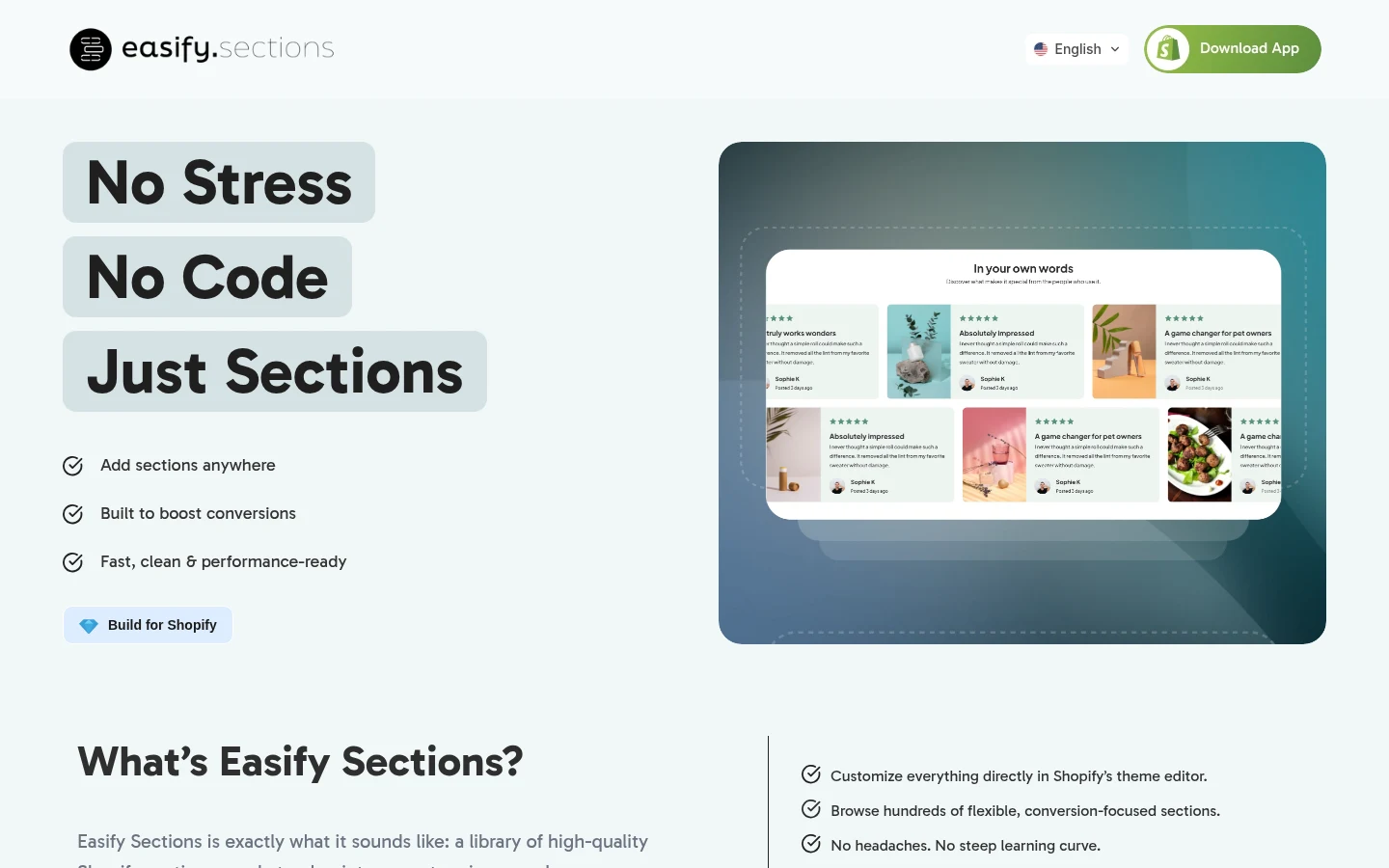
The existing portfolio page includes a desktop homepage screenshot for Easify Sections. It is a visual reference for the project’s public presentation, not proof of sole authorship or a complete record of the app interface. Read the image alongside the partnership attribution and the two documented deliverables.
Visit https://easify-sections.io/ to review the live website’s presentation of the product, section library and how it works. Compare that explanation with the homepage screenshot while keeping the product and marketing website distinct. The project demonstrates a client partnership spanning an app and its website; it does not document which partner owned each individual implementation task.